We hold these tooths ...
The first story in Self Evident: We hold these tooths

We hold these tooths ...
I think it goes without saying—which is, of course, ever and always a lead-in to saying what the speaker has just told you didn't need to be said in the first place—that it is the unvarnished tooth that draws our attention. Am I right? Of course I'm right.
Sometimes, I'll be the first to admit, it is “tooth and claw” (italics mine) that rivet us. “Red” said Tennyson, and he was occasionally on point, but I submit it is the tooth that most bemuses us. As I faithfully recorded in “Jack,”1 when I was on that rocky ledge looking down and the bear was looking up at me the claws were an afterthought. The large canines felines revealed as he wrinkled his nose and snuffed, clearly evaluating meal potential versus risk/effort and so forth, caught my attention right off.
It took a few beats before it sank in that whither I had clambered with my trusty Vibram® soles, the very large and surely hungry beast could easily scale with those large and surely trusty claws. You see: tooth first, then the rest.
Fortunately the fictional “I” was possessed of a somewhat larger brain than Teddy and “I” was able to make my escape. But that was a story for a previous time.
We were discussing teeth.
Two days ago (as I compose this little parable) I was downstairs looking for a birthday card for a dear friend whose birth date I did and do not know at this writing, but who deserved one anyway. It's the sort of thing I do. Someone has to.
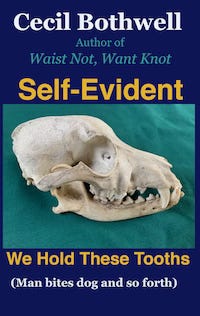
I was relatively certain I had a few stray cards in a box down there amid the rubble.2 Peering into a possible candidate I spied the skull featured on the cover.3
Naturally enough, I did what you would do in similar circumstances, you being curious and intellectually adventurous (as I know my readers to be). I picked it up and spoke aloud, “For in that sleep of death what dreams may come, When we have shuffled off this mortal coil ...” The dog whose neck this had one time been attached to had ages ago shuffled off, long before I found it, at least thirty years in the past. So if the pup was named Horatio or some such, I could never claim to have “known him well.”
This reminds me of something I've not thought about in nearly forever, so we'll get back to Dog1 in a few. Funny how memory works, pinging around like silver projectiles in a pinball machine. Silver is the operative descriptor here. Once upon a time, true story, I painted a dog4 skull silver. (Why and how I happen to stumble on skulls when I'm out and about is somewhat mysterious. I want to assure you right now, this instant, that I do not “collect” them from the living. First they have to shuffle off on their own.) I painted it silver and put it on a cushion of purple velvet in a fancy, hinged, enameled gift chest about three-quarters the volume of a size 125 shoe box. I tied it with a ribbon and gave it to my then-ladylove.
Again, this is something I do. Somebody must. I always like to remind myself that it's the thought that counts.
She was surprised!
Horatio, (D1) as we've seen on the cover, had a nice set of chompers. He/she was a fairly small critter, no threat to, say, the bear that more or less fictionally treed6 me. But fully capable of self-defense in the realm of lesser adversaries, which makes one rather wonder how the poor pup ended in the woods.
For that's where this un-silvered object turned up. It was a good three hundred yards (274.32 meters for those of you residing in more scientifically rational countries) from the nearest road, so it's relatively unlikely that Horty fell to vehicular homicide—the all too frequent fate of creatures who take to warm pavement on chill evenings.
Which, excuse me, takes this author's train of thought clean off the current track. So, more on teeth in a sec.
Driving on a long stretch of two-lane blacktop in, I think, North Dakota, though maybe South,7 just at dusk, the evening starting to chill, September I'm pretty sure, running through vast fields of potatoes or corn or beets (I was driving, not studying agricultural details at the time, and as noted, it was “dusky”) there were dozens and dozens of corn snakes8 on the highway. They were clearly savoring the sun-leavened warmth of the pavement. I hit more than one before I realized how many there were and slowed to, appropriately enough, a crawl, to avoid hitting any others. Strange phenom. We are bulls in nature's china shop for certain.
Which reminds me of chickens, as such things will.
When I lived in the marshy woodland whence discorporated and latterly ascended our dear Horatio, I kept chickens. Free range by day and cooped at night, safe from marauding raccoons,9 their diet was healthy and varied. Never more varied than after the sort of rainstorm that brings out frogs eager to mate in newly puddly love nests. I would describe the mounting and milting and so forth but this anecdote is intended for a General Audience.
They set up a raucous clamor, announcing their stellar character traits, wooing and croaking, “Kiss me! I'm a prince!” and so forth. And for some reason crossing country roads in vast numbers. No match for Mr. Goodyear® and Mr. Firestone® and Mr. Michelin®, though one might profitably compose a Michelin Guide® for Fowl, with star ratings on various byways.
Chickens love to eat road-killed frogs. One rather doubts that a chicken would be particularly handy at collecting live hoppers, or at least this former chicken-keeper entertains such questions. But dead ones? Gobble, gobble.
I see a hand up. “Eggs?”
You're on the money. The eggs would taste faintly fishy for several days or a week thereafter. An acquired taste. At least on the part of the egg. Happy to report that none of the chickens ever fell victim to the Misters three grafs up. Daytime diners, they were presumably spared by my rural neighbors, chickens being a regular and valued feature of the locale. Not so with the duck, in another place and time. As the saying goes, “It takes all kinds.”10
Be that as it may, chickens don't have teeth, as we're reminded in the other saying, and this story, we recall, is about teeth, or “tooths” (as indicated in the title.) So it's time to get back to Horatio.
Another hand up? Look, I'm trying to get to an important point here. Can it wait? No? [Sigh.] Okay, shoot.
“Ducks? You kept ducks?”
Full disclosure, I did tend ducks some years before that, for about two years if memory serves. They weren't my ducks, by the way. Do I look like the kind of person who would have ducks? No. Next you'll imagine that I'm a golfer. I want you to rest assured that I have considerably higher standards and would voluntarily engage in neither, nor several other shady activitiesabout which I might arrive shortly—if I'm not interrupted. I hope I've made my point.
Seriously, I'm hard at it trying to concoct a passable form of fiction and I keep getting spooked off into a memory hole. Look, they were my landlord's ducks. Okay? And the rent for the farmhouse with a pond was below market with the stipulation that the ducks be fed, and with the landlord providing the food.
Now I've mentioned food and I'm going to have to flip a coin.
Tails it is. So first the duck food and then the frog food. Again, the following is absolutely true. I'm trying to concoct something here, a fiction, but, oh no, you want the truth.
The so-called “duck food” provided was in the form of boxes and boxes and boxes of army surplus “cracker/cookies” in tin cans. Where and how the landlords (for it was a couple) came up with that quantity of surplus “cracker/cookies” is a deep mystery. WWII? Vietnam? Some other among our national pastime of invasion and mayhem? Every day we'd11 open cans and walk out toward the pond, crushing the crackers and cookies and scattering them. The flock would race, chortling in their joy, calloo callay, from pond-side toward the house, flapping and craning their necks, finally to dig through the grass for their daily bread. Or, perhaps, communion wafers?
The Preacher was the odd-duck-out, and as it later happened, was the one that got flattened: Canard à la presse—though run over rather than asphyxiated à la française. I suppose the entity formerly known as “duck” was dead either way, mangled or strangled, but the latter seems somehow sad. Dead in the way that the musician formerly known as Prince12 has ethered on, neither mangled nor strangled, yet also sad-making.
[Insert pathos.]
The Preacher, however, leads us back to the second true story involving ducks, which, as fate would have it, also involves— you guessed it!—A frog.13 Again, I wish I could make this stuff up.
One day, early in my duck-husbandry (midwifery?), there arose a mad tumult down by the pond. The adult fowl were hooting and hollering to beat the big band, and the little yellow ducklings were scooting all over the pond, cheeping to beat the jazz trio. When I arrived pond-side I discovered a large bullfrog attempting to swallow a duckling but only able to engulf the head. So the little guy was flapping like crazy and the frog seemed kind of dazed, like it had bit off more than it could chew.14
I picked up the pair, docked like two spacecraft, and gently pulled the duckling out of the diner's orifice, which turned the frog somewhat inside out—but I poked his innards in and I saw him on subsequent days, so he survived the incident. Frogs and other amphibians are remarkably durable creatures until confronted with human-generated toxins which seem to be knocking down their numbers globally. (Universal roadkill.)
When I turned duckie loose he scooted back to Mom on the double and I assumed all was well.
Not so. The Preacher, as he came to be known, survived, but with collateral damage. He tended to run in circles. He'd come charging ahead of the flock at mealtime but continually circle around, squawking at his brethren and sistren, exhorting them torepent—hence the appellation. And one feather on the upper left side of his head grew straight up, like a single eagle feather in a Native American headband. Once you got past the pathos and shifted to bathos it was easy to laugh. Comical isn't the half of it.
But, again, we're talking teeth (tooths) here, entirely out of the realm of frogs, ducks and chickens. Or salamanders, those other tetrapod vertebrates of the class Amphibia.
Toothless as dear old Aunt Emma [RIP15]
When we look at the dentition of, for example, Horatio, we are looking into our mammalian and reptilian and presumably avian not to mention amphibian and ichthian past. Somewhere, way back, tooths became a good idea. But not for everybody. I feel sure D1 was pleased with hers/his.
Note, now, what are commonly referred to as the canines, an odd appellation given that they first developed and evolved to their highest glory in cats. The saber-toothed cat was nothing to sneeze at, and in point of fact, that would pretty certainly be your last sneeze. Here at the cat ranch we always put credit where due and refer to the long ones as “felines.”
So we are examining Merc's felines. Both in excellent condition. These and the rest suggest that the dog was not old. Elders, like Aunt Emma, are often possessed of poor dentition.
What do you suppose Horatio munched on? We know, given the location of his discovery, that he/she was a pet, perhaps escaped or lost, but domestic dogs in the modern era, and in the U.S. particularly, are either dedicatedly domestic or strays.
[Moment of pathos.]
But I'm inclined to think that only someone who cared deeply about animals would have named a dog Horatio, and more than likely I can drop the her/him now and just go with “boy dog.” Jim wouldn't have given a girl dog a masculine name. It just isn't done. And, let's face it, anyone who fishes around in Shakespeare's knapsack for a dog name is a refined and uplifted sort. Admirable. Salt of the library. Not, we can be sure, a golfer.
Horty was a gift from Jim's gal pal Samantha.
This is a clue regarding their relationship. You have to know someone pretty darn well to give them an animal. Pets require responsibility, and you are dumping a load on the recipient. Ten years? Sometimes fifteen with small sorts like old Horty. Reminds me of Irma. Irma Burger. Talk about rebounds!
You noticed I said “gal pal” rather than “girl friend” or “significant other” or “amoureuse.16” Good to know you're paying attention. This phrase indicates that the two were quite close, but not that close. Brotherly/Sisterly close but not procreational frogs in a puddle, no mounting and milting to coin a phrase, and more about that elsewhere. At least in regard to Samantha, who was not and is not, even at a fairly advanced age, celibate.
Longtime friends.
See, Sam knew that Jim was: 1) Kind of a loner, content to be unpaired in a connubial manner, an unconjugated verb of a man; and 2) That a smallish dog would give Jim someone to talk to without imposing the burdensome machinations of large mutt ownership. Great Danes only seem like a good idea at the time. Ditto with Irish wolfhounds.
Because we do. As I've admitted time and again, and if you're a reasonably normal person (and hey, you're on page 19 already so you passed the screening) you as well, talking to pets and house plants is part of the deal here on Big Blue. Portraits as well, and cars, particularly when the Needle's. On. Empty. And there's no gas station in sight. “Come on Buckwheat,17 we can get there. You can do it. I know you can!”
Lord18 knows Sam was right. Horty and Jim bonded. How can one not, with a cutsey-wootsey puppy dog? Not that Jim was ever, or would ever have been, caught dead using that sort of language in public. It just isn't done. By men. In public. Stern reserve is the rule. Keep all that sentiment bottled up and you'll be fine. Just fine.
“Cutesy-wootsey” was held back for when it was just the two of them, though Jim picked it up from Sam who being a woman, was permitted to say this sort of thing in mixed company. I don't know who wrote the rule book, but you have to admit it is pretty damn strange.
All of which meant that Jim fed Horatio …
Hand up again? Really? Must you?
“Irma Burger?”
Later, okay? Pinky-swear. I'll get back to her.
Um, oh, right. Jim fed Horty good quality dog food and table scraps. He was that sort of a decent human being. And there was about a quarter of a bag of chow, and a few cans as well [insert pathos here], left over when the dog shuffled off this mortal coil.[He gave the food to Samantha, about whose dog more in a bit.]
Jim heard the gunshot but thought nothing of it in the moment, gun shots being part of the soundscape of country living. It was only late in the afternoon, toward dusk, that the absence presented itself. Jim called and called.
And never found his lost friend.
Meanwhile all of the true parts of this story are actual fact including, most particularly, the birthday card search and the picking up of the skull which triggered the naming of this book and this story. I will try to steer clear of nonfiction henceforth.
But please, please, try not to interrupt.
*****
1 See Fifty Wheys to Love Your Liver, p. 59 (Fiction, yes, but faithfully recorded.)
2 How some people fit all of their junk in a “drawer” is beyond me.
3 Also featured in a painting “After Darwin,” last seen on the cover of the first edition of Can We Have Archaic and Idiot? 2, (Brave Ulysses Books, 2009.) The painting sold in a charity auction and is untraceable.
4 We'll refer to this specimen as Dog2.
5 My size, if you're looking for gift ideas.
6 Up a rock face. So “treed” is metaphorical. Treed me fictionally.
7 Long ago. Memory is extremely flexible. Like Silly Putty®.
8 Surely one of the most beautiful serpents native to North America.
9 A story for another day.
10 Noah reputedly adhered to this one.
11 I was coupled at the time as well, as versus the present moment.
12 Princes and frogs having a long and storied history.
13 See what I mean?
14 Though as you know, frogs do not have teeth either. Odd that we never say “Scarce as frog's teeth.” (Fr. “Rare comme les dents de grenouille.”)
15 You will gradually come to understand that this is irony. High irony.
16 Inserting a French word now and again really fancies up a story, non?
17 The name of one of the author's former vehicles, a blue VW squareback. This did not actually happen, but is used as a hypothetical.
18 Used here for literary emphasis. No religious implication intended.
Copyright© 2020, Cecil Bothwell, all rights reserved