Jawboned
A tale in “passing” from Self-Evident: We Hold These Tooths

Jawboned
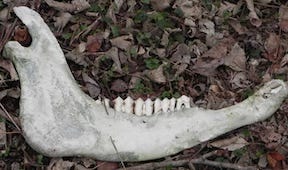
I have in my possession the mandible of a steer or a horse.1 I really can’t say which and have been incurious enough for well over fifty years of ownership never to have explored its origin further. But I can say this about it with absolute certainty: If it in any way resembles the jawbone of an ass, then I have to seriously doubt that Samson slew one thousand Philistines with such a weapon.
There, I said it.
But (and isn’t there always a “but”?) I know there are people who believe such things, bless their hearts, and if you’re one of them, well, well, well. What are you doing here?
Bones do fascinate, do they not? Hamlet® is/was hardly alone in pondering remains. Harbingers of what’s to come, relics of what once was, and, in the moment, redolent of both endurance and ephemerality. [A month shy of three score and ten as I compose this tale, I am no stranger to thoughtful consideration of ephemerality.]
It’s not at all hard to imagine how Lenny felt when he discovered what he thought was a chicken bone hosting a wedding ring and instantly suspected that the “chicken” finger in his hand was quite likely human.2 We all agreed that he was lucky to have a forensic pathologist as a neighbor.
I think we all also agreed that they were both lucky, or as they say, both “got lucky.” But (another “but”) that tale has already been told, so enough said here.
Frances is as besot with “dem bones” as you or I or Julia. (Lenny’s love interest, the gloriously tattooed forensic expert two paragraphs up. But I’m not going to retell that story here. If you want to know more about whither slithers the image of the emerald tree boa that goes over her shoulder and down into her tank top, you’ll have to ask her, or Lenny. Never having seen Julia in the altogether I certainly have no clue.)
Like Julia, Frances found her calling in forensic pathology, yet unlike Julia she managed to avoid the obvious misappropriation of funds involved in a full-body tattoo.
But where does she work? [You ask.]
Well for a good long while she studied and then worked at the Body Farm at the University of Tennessee. You know, where they set corpses out to rot to get a handle on the process—the timing, how outcomes are determined by initial conditions and so on and so forth. The things you want to have a grip on when you stumble on a body in a serious state of disrepair.
Julia is an alumna of the same school.
In pensive moments she sometimes wonders if the long-term break-down of tats has been a subject of study in the years since her graduation and subsequent adornment.
In point of fact she has willed her body to the school, so perhaps they’ll have a chance for that, anon.
I think we can all agree it takes a certain level of detachment to offer up your body to rot in a car trunk, or a swamp, or even a shallow grave, to be discovered (repeatedly) or exhumed (ditto), clothed or unclothed, etc. and etc. in the name of science.
Frances is no less committed to science, but is of a more ... what would you call it?
While you think about that, we can move along with the story. I’m sure you’ll come up with something, and this will save time
Jennifer, who is Frances’ sister, is kind of grossed-out about the whole thing. She couldn’t believe that her sister was willing to spend years, literally years, poking around in corpses. I would venture to guess that Jen is not alone in her feeling.
You?
If Frances could be described as devoted to impermanence, Jen, I think we can agree, was her opposite. She arrived at her current trade, stone masonry, after some years as a tile setter. What she understood—and deeply—following her stint laying floors, facing walls, and decorating counters was that they were all subject to disruption.
(Though, as we shall see, goals morph.) (Oh, do they!)
A house in Jen’s neighborhood burned—a dear friend’s home, by the way—and Deborah was grateful for help sifting through the pyre. Little remained save for the stone fireplace and chimney. The cabinets Jen had so artfully tiled? Ash. Half the kitchen floor that Jen had similarly graced collapsed to the basement. The shower surround? Shattered into the porcelain tub, now cracked and resting on the concrete cellar floor.
Oh how large that chimney loomed in Jen’s imagination.
Stone endures. Viz: Great Pyramids; Machu Picchu; The Plain of Jars; Easter Island.
Easter Island!
Easter Island!
Soon after her revelation she signed on with Lowell Marston, a third generation stone worker who was—at first at least—amused by her ambition. He strongly believed that his trade was the sole province of men and so was only slowly disabused.
But disabused he is, and rightly so. Jen is not a particularly large person, but she is strong as hell and clever and determined.
I watched her work one day and in order to describe what I saw, we need to step back a little.
Step.
Step.
That should do.
In postcolonial New England it was fairly common practice, among those of some means, to construct house foundations of dry-stacked fieldstone capped with large blocks of granite. So, above ground level, what you’d see was a series of grey, cut sections, say two feet tall by eight or ten feet long.
The dry-stack was pretty stable, founded at least four feet down, below frost level—frost heaves being the great enemy of ineptly laid masonry structures. Topping that off, literally as well as figuratively, the multi-ton slabs tended to hold things together. Once set they weren’t much inclined to wiggle.
However, as we considered on page 72, Mother Nature bats last, and here we note that most of the magnificent stone structures that have survived since antiquity are closer to the Equator than Olde New England.
Frost? Not so much.
Stonehenge? [I hear you ask.]
Well, England, coddled by the Gulf Stream, is pretty balmy compared with, say, New Hampshire, which is chilled by the Arctic outflow when the ocean current starts back south.
But back to Jen’s project. The movement of soil due to Ma Nature’s icy ways is not wholly vertical. Lateral motion over centuries eventually pushes and shoves and dislodges, and “this old house” begins to settle. This tends to happen at the outer walls, the central chimney having been less prey to ice.
There’s nothing for it but to jack up the place, lifting all two stories and 1,700 square feet of wood and plaster and glass clear off the foundation. Careful now. Only just clear, far enough to level the place at its original stance plus about an inch. You don’t want to stress the chimney. All you need is a little clearance.
The southeast corner is the trickiest: That’s where the foundation failure was worst and the building has settled almost four inches. Take it up a little bit at a time.
That’s what Jen did. Incrementally. Checking, always checking with both her transit and her six-foot level, supporting the whole on cubical stacks of railroad ties. She’s both adept and patient and managed the lift with very little new cracking of plaster. (The southeast corner was already in rough shape.)
Being somewhat diminutive is a bonus in a four-foot-high crawl space, let me tell you!
Then she hired Tobey Comtois, from over in Exeter, to come in with his backhoe and dig a trench all around the place.
On the day I stopped by, Jen had already removed three of the granite slabs which were then sitting on still more rail ties well clear of the underlying wall. If I hadn’t watched her work I would likely be willing to believe she danced those stones the way Merlin® was said to do on the Salisbury Plain.
But no, she used a six-foot-long pinch bar and scootched the things a bit and a bit and a bit and with that Archimedean long-enough lever, using her creosoted rail ties for a fulcrum, she displaced their quasi-Archimedean world from their century-old orbits.3
I didn’t get back by the job site until she had finished things up, the dry stacks rebuilt and the granite capstones back in place. Likely better than “good as new.”
Lowell told me to go by and take a look. “She’s a wicked good mason,” he said, shaking his head. “Wicked good.”
But since then Jen has drifted into ephemera. Challenging Mom Nature I think.
Or, what would you call it?
Serpentine spirals, loops and curls, stone structures certain to fall prey to earthquake or frost-heave or the exigencies of time in whatever form. Tempting fate, it seems to me. Saying to dear Mother Nature, “Bring it on!”
Kind of, in her own way, getting a full body tattoo and asking the world, “What do you do with this?”
But being possessed of some deeper knowledge of Jen’s thought (having, obviously, invented her), I would interject this: Peering through the implicit lens created by one of her stone circles, Jen arrived at the deep sense that the gates to heaven and hell are one and the same. Only one ticket, and it entirely depends on where you think you’re going. Step right up. All possibilities are just through that masonry arch. Here’s your boarding pass!
So-o, I think you’ve had some time. Remember Frances?
Well, what do you say? Come on, how would you react to several years of watching bodies rot? You, I can tell, having made it a full 90 pages into this morass, are less detached than, say, Julia. For one thing, I’d bet $5 you don’t have a full body tattoo.
Am I right?
And you don’t golf. I feel certain.
See where this is heading?
It clearly takes detachment to get that much ink in your epidermis, and pathological detachment from the real world to fritter your life away chasing a dimpled ball around the links.
So how did Frances react?
You. People. I. Swear.
Frances intends to be eaten by ravens. Like Bernd Heinrich, author of that marvelous book, Ravens in Winter. A highly recommended read. (Summit Books, 1989)
(She is a spiritual sort. Or something airborne at least.)
Wasn’t that obvious? Did you ever, for a moment, think otherwise?
And you. Are you going to be eaten by ravens? Why or why not? That’s my goal. To make you think. For once.
Oh, and Frances now teaches at the Western Carolina University body farm formally known as the Forensic Osteology Research Station—or, more commonly, as the FOREST, tending what we might call “corpus campus corpses,” if we were given to silly alliteration. Which we are not.
We are not.
At this point, I believe we can all agree, you have been jawboned in the non-Samsonite, AKA “modern manner.”
“Talked to death.” (I could have warned you.)
Okay, shoot me. (Donna?)
********
Note per footnotes: Substack renumbers when I post, but footnotes sometimes refer to previous super important stuff in the print version, so originals are in [#].
1 [121] I know you’re seething with jealousy right about now.
2 [122] In the aforementioned tale “Arose.” See footnote 53 if you’ve already forgotten. Vitamin D3 is said to help memory. Just sayin’. (Not to be confused with D3.)
3 [123] Used here in the sense of an eye socket rather than a planetary path.
Copyright© 2020, Cecil Bothwell, All rights reserved
Want more stories? Check out my website!