Gnawing Desire
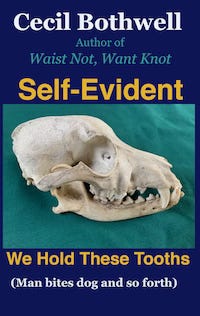
A chewy morsel from Self-Evident: We Hold These Tooths

Gnawing Desire
When you think about it, which one certainly should, this “G” plus “N” business is confusing, not to mention the fact that every time anyone thinks about “gnawing” they immediately acquire an ear-worm about dining on rugbug bark.

Am I right? Of course I’m right.
So let’s avoid that and start, instead, with gnu. Pretty much everyone I know pronounces the “G” at the front end of this African name for the wildebeest, but that is wrong. Wrong, wrong, wrong. If you say “g-noo” you are talking about a Linux operating system, not a highly specialized and very successful ungulate herbivore of the African plains.
The critter is a “noo.” Why then the “G?”
I’m glad you asked.
When Europeans decided to colonize Africa and moved in with their strange habits, strange clothing, strange tools, very strange attitudes and greedy little fingers, they asked the locals what those tall, dark, curved-horned, sort-of-cattle-like-only-not-really beasts might be and were told [click]noo. Being quite fully disinterested in local linguistics, the strange white people, taken as a whole, didn’t bother to learn that the [click] was part of the correct pronunciation. Nor did they learn to [click].
When they sailed back home with their loot and their slaves and so forth, they told a dictionary editor about the beast and the name and one of them, having paid a tad bit more attention, said that it seemed like all the locals either had a speech impediment or, perhaps, liked the sound of [clicks] … sort of like snapping one’s fingers when remembering: [snap] Rats! I forgot my keys; [snap] Rats, today was her birthday!1
“Only it was more clicky.”
Editor: “Like a k-nu? That’s going to be confused with canoe, don’t you think?”
“No, more like a “G” sound.”
So we were graced with gnu.
The obvious problem with the correct pronunciation is, of course, the confusion it sows.
Say you and a friend are on walkabout out on some verdant stretch of African savannah and your friend says, “Hey, I saw a noo”.” What is your response?
Obviously you’d go in one of two directions. Either you’d ask, “A new what?” or you’d think your companion had just had a sort of Biblical revelation as in, “I saw anew.” Okay, maybe not Biblical but more carpenterial (and Jesus, we are told, was such), as when a wood-butcher plonks a plank across horses, picks up a tool and announces, “I saw anew!”
Eminently clear, I believe, that had your buddy simply said “I saw a g-noo” the mystery would have solved itself, though knowing your friend I actually don’t think he knows a gnu from a warthog or a zebra. But that’s a whole nuther ball of wax.
Gnuther?
This doesn’t get us any closer to gnawing, does it? Where did that “G” come from, and if all of my unsophisticated friends say “g-noo” why don’t they say “g-naw?” For that matter why don’t they say “g-nostic” or “g-nome?” And why no “G” in nail? The builder in me wants to know. (Begging the question, why do we want to “know” something, when “noing” would be perfectly acceptable and waste less ink? Or, for that matter, why the “A” in canoe? “Knu” would work just fine.)
Which begs the further question. Why do we have two silent consonants to deal with? Couldn’t we just use one or the other if we so badly need the implied [click]?
This is what keeps Jerry up at night. That and the ear-worm. Gnawing on rugbug bark often wakes him at 3.
Jerry, we see, is what we’ve come to no as a grammar Nazi (G-nazi?), oh yes. And a pronunciation Gnazi as well. Oh, and spelling.
The folks who don’t no lose from loose drive him gnuts.
That isn’t what this story is about. But understanding, or “noing,” a bit about Jerry at the outset is likely to stand us in good stead. Jerry, to further introduce the fellow, is as unlike, say, Benj [RIP2] as is reasonably possible, apart from both being adult male humans.
Jerry is, for one thing, chock full of brilliant ideas—but, and it’s a big “but”—never acts on them … beyond, of course, shooting down grammatical errors on FaceBook and Twitter, which he does with acerbic wit, his verbal vorpal sword snicker-snackering away. Slices them to ribbons, he does.
As a result, Jerry is very unlikely to be stung to death in a motel room, [previous story on Substack] but by the same token he’s very unlikely to become the next Steve Jobs or Elon Musk or even some upper mid-level success story like, say, Ellen Burkett.
Burkett, as we all recall, did very well for herself. Very. Spunk and creativity and drive, going all in when in-going was sometimes tough. And she’s outgoing as well!
When the going gets tough, Jerry gets going … somewhere else.
I remember the first time Burkett was featured on the cover of, well, I don’t remember which national magazine, but I do remember the picture. Burkett and her brilliant invention. I’m sure you’ve seen it too. Smart cookie, that one.
Jerry is smart as a whip as well. I don’t mean to suggest he isn’t. He’s just … ah, content to plug along, dreaming his big dreams and … nothing.
“Plug?” you ask. “What does he plug?”
“Holes,” I answer. “A regular little Dutch boy.”
Truth be told, if Burkett hadn’t gone in and done what needed to be done, someone else would have. It’s the path we’re on these days, but like those who have gone before, it’s the early bird who gets the best worms. First come, first served and all.
“What kind of holes?” you ask.
“Carpenter bee holes, naturally. Carpenter bees chew3 tunnels in wood, boring in to create a cozy home place for their kids, and doing serious damage to human structures. The holes must be plugged, else woodpeckers will join the party. Jerry’s your guy.”
Where was I? Oh, yes. Burkett’s invention solved a key problem facing 21st century humanity, with a simple trick using a patented device that turned the tide. Like the fabled developer of the much vaunted “better mouse trap,” she soon found the world beating a path to her door.
“You mean to tell me that plugging bee holes is an actual profession?” you inquire.
“All in a day’s work. For a house painter.”
“So you’re just dressing up a plain-Joe house painter as a professional bee hole sealing professional? Sounds like kind of a jobbernowl to me.”
“Not my idea, and you are being unkind. The bee claim is plainly spelled out on Jerry’s business card. He thinks that’s the real importance of his work. ‘Paint, shmaint’ is his attitude. In fact he refers to that document as his ‘bees-ness’ card. He’s kind of a murder hornet where carpenter bees are concerned. Carpenter bees and bad usage. Snicker-snack.”
“Jobbernowl indeed.”
But I was trying to tell you about Ms. Burkett, though, I can see that you may well already have read about her startling and useful contribution to the weal of the world.
The idea was simplicity itself, but she faced serious adversity once hosiery manufacturers caught wind of her enterprise. She spent the better part of three years in court—not that the outcome was ever in serious doubt. Even the Chief Justice puts his socks on one at a time, don’cha no?
How many person-years have been wasted in fruitless searching for a matching sock? That was the question that triggered her quest.
“Many, many,” is the correct answer, in case you found yourself momentarily baffled.
The notion that socks in the laundry are somehow sucked into a parallel universe is an amusing concept, but Ms. Burkett, with her strong background in quantum mechanics, not only proved that to be as impossible as it clearly feels improbable, but solved the mystery and patented a solution!
She is a very rich woman today.
Your humble author solved the problem in a more prosaic manner,4 obviating the need for higher mathematics and gadgetry—but then your humble author has never graced the cover of Time or Fortune or Cosmopolitan.
More’s the pity. A wormless bird, in word and deed.
Jerry, meanwhile, addresses a problem every bit as prosaic as the matter of missing mates—rendering mates missing in point of fact—with a caulk gun, sealing the gnawn gnotobiotic habitats of the aforementioned insects with missionary zeal.
A gnarly gnome if I’ve ever gnown one.
Our language lesson of the day is that the word gnu is the only three letter English word starting with “gn.”5 [That will someday help you with a crossword.]
Now you gno.
*****
Note per footnotes: Substack renumbers when I post, but footnotes sometimes refer to previous super important stuff in the print version, so originals are in [#].
1 [91] More about snaprats anon.
2 [92] Ironic. But see page 67 if you skipped ahead.
3 [93] As promised, we never wander far from the tooth in these stories.
4 [94] Blacks and whites only, all matching, so the question of pairing is rendered moot. Whether or not some end up in the Chrono-Synclastic Infundibulum is of only academic interest hereabouts.
5 [95] Per thefreedictionary.com
Copyright© 2020, Cecil Bothwell, All rights reserved
Wanna buy the book? Click here.
Cecil Bothwell is the author of 18 books including the novel She Walks on Water, Brave Ulysses Books, 2010. A story of love and loss and psychic connection with dolphins that runs from earthquake crushed Haiti to tsunami-battered Japan and finds hope in mindfully feeding the soil and the soul.